

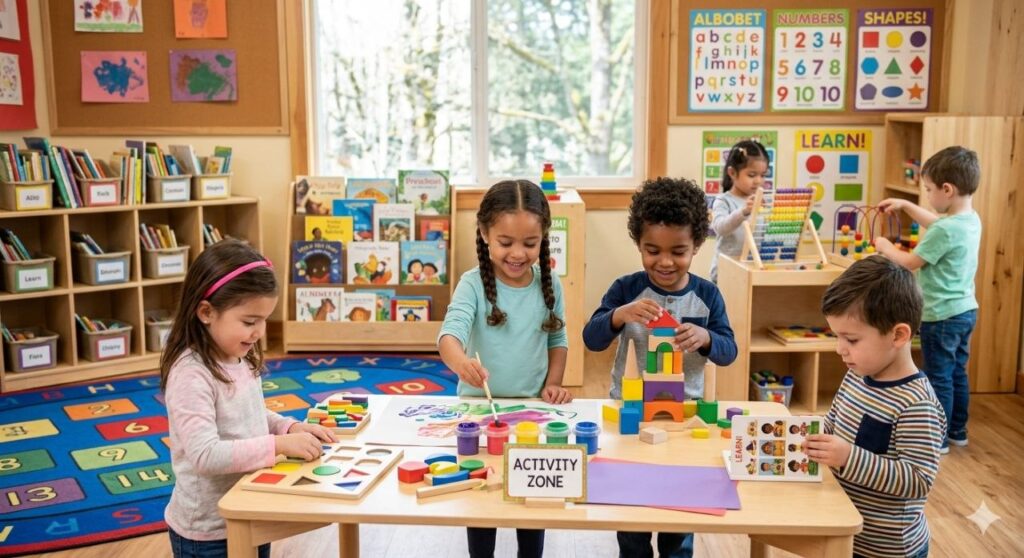
Essential Preschool Learning Activities for Early Development
Finding the best preschool learning activities for your child is essential for development
Early childhood is a critical period for brain development. Engaging children in the right educational activities for preschoolers can set the foundation for lifelong learning. Between the ages of 3 and 5, a child’s brain is like a sponge, absorbing information and forming millions of neural connections every second. Here are seven highly effective activities to boost your child’s cognitive, physical, and social growth:
1. Interactive Storytelling and Reading
Reading is more than just looking at pictures; it is the gateway to literacy. To make it interactive, ask open-ended questions like, “What do you think happens next?” or “How do you think the character feels?” This builds complex vocabulary and critical thinking skills. Regular reading sessions improve language fluency and empathy, as children learn to connect with different characters and diverse perspectives.
Interactive storytelling and reading provide essential preschool learning activities.
These interactive preschool learning activities, including educational games, are very effective for early development.
2. Sensory Play with Colors and Textures
Sensory play is essential for preschooler development. Using materials like sand, water, or non-toxic playdough helps develop fine motor skills and hand-eye coordination. When children touch and feel different textures, they send vital signals to their brains, strengthening neural connections. You can also incorporate sorting activities—using colored beads or different shaped pasta—to teach mathematical concepts like classification and patterns simultaneously.
3. Basic Math Games and Counting
You don’t need worksheets to teach math. Use everyday objects like fruit, blocks, or toys to teach counting. Simple addition or subtraction during playtime makes math feel natural and fun. For example, “If we have three apples and eat one, how many are left?” This builds a strong “number sense” and logical reasoning before they even start formal schooling.
4. Creative Arts and Crafting
Drawing, painting, and sculpting are not just about making art; they are about decision-making and self-expression. Providing various tools like crayons, safety scissors, and glue encourages “motor planning.” As children learn to control a brush or cut along a line, they are developing the same muscles needed for writing. This creative freedom is vital for emotional health and confidence.
5.Outdoor Nature Exploration: A Key Preschool Learning Activity
Nature is a giant, living classroom. Walking in a local park or even exploring your own backyard allows children to observe biology firsthand. Collecting leaves, watching insects, and discussing the changing weather helps develop scientific curiosity and observation skills. It also provides an opportunity for physical exercise, which is directly linked to improved focus and better sleep patterns in young children.
6. Music and Rhythmic Movement
Music is a powerful tool for neurological growth. Learning rhythm and rhymes helps with auditory processing and phonological awareness, which are key building blocks for reading. Dancing to music improves gross motor skills, balance, and spatial awareness. Try “freeze dance” games to help children practice self-regulation and listening skills.
7. Cooperative Board Games and Role-Play
Playing simple games that require taking turns teaches patience and social-emotional intelligence. Role-playing (like pretending to be a doctor or a chef) helps children practice social roles and language. These activities help children understand social rules, cooperation, and how to handle both success and disappointment gracefully.
The Role of Parents in Early Learning
As a parent or educator, your involvement is the most important factor. You don’t need expensive toys; your interaction and encouragement are what drive child development. When you engage in these activities, you aren’t just “playing”—you are building the architecture of the brain.
Why Structured Play Matters
These activities are designed to cover all areas of development:
Cognitive: Problem-solving and memory.
Physical: Fine and gross motor skills.
Social-Emotional: Sharing, empathy, and confidence.
By spending just 30 to 45 minutes a day on these structured activities, you are providing your child with a stimulating environment that fosters curiosity and a love for learning.
If you are looking for high-quality childcare in North Vancouver, Luma Childcare is here to help your child grow.
Leave a Reply