

In the landscape of British Columbia education, Reggio Emilia inspired programs are gaining significant momentum. This innovative approach, originating in Italy and now widely adopted in Vancouver preschools, offers a profound alternative to traditional learning models. The philosophy recognizes young children as capable, curious, and resilient learners. The unique environments of modern BC preschools nurture development in ways that standard curriculums often overlook. By understanding the foundational skills fostered in these settings, parents can better appreciate the holistic development a Reggio Emilia approach provides. Here are four essential skills that children develop in these dynamic learning environments.
1. Complex Collaboration and Social Dialogue
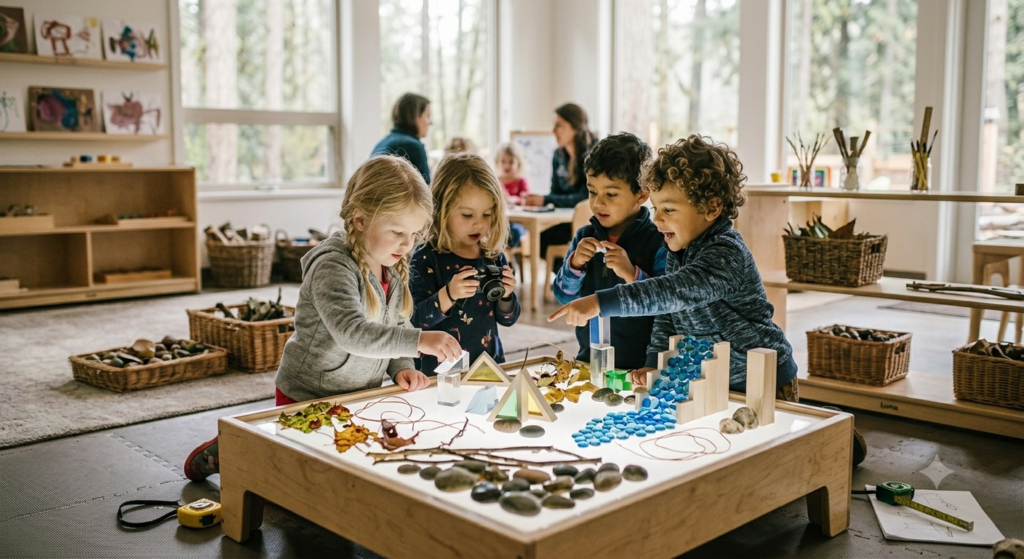
One of the most immediate observations in a Reggio Emilia classroom is the emphasis on project work. These projects require children to work in small groups, defining objectives, negotiating roles, and sharing perspectives. Children in Vancouver preschools practicing this method do not simply play alongside each other; they engage in genuine, complex collaboration. Educators act as facilitators, helping children navigate conflicts, build empathy, and articulate ideas clearly. This environment transforms social interactions into rich opportunities for democratic dialogue and shared inquiry within BC preschools.
2. Multi-Modal Expression through “The Hundred Languages”
Reggio Emilia philosophy famously posits that children have “a hundred languages”—hundreds of ways to think, express, and understand. A robust program ensures children are not limited to just verbal communication. Instead, top-tier BC preschools provide vast opportunities for children to use art, light, movement, sculpture, shadows, music, and dramatic play as serious tools for investigation. A child might explore the concept of light by drawing it, then building a structure to catch it, and finally choreographing a dance about shadows. This multi-modal approach cultivates sophisticated creative and symbolic thinking skills.
3. Critical Thinking and Reflective Inquiry
In a Reggio inspired setting, the educator’s role is not to provide answers, but to listen and propose deeper questions. Children are encouraged to form hypotheses, test them, and reflect on the results. This cycle of inquiry builds strong critical thinking and problem-solving skills. The classroom environment itself—often featuring natural materials and open-ended resources—stimulates curiosity and encourages children to explore “what if” scenarios. By valuing process over product, these certified BC preschools teach children how to think, rather than what to think, fostering lifelong curiosity.
4. Self-Regulation and Democratic Citizenship
Reggio Emilia classrooms emphasize the importance of community and documentation. Children see their learning visible through photos, transcripts, and displays. This practice builds self-awareness and helps children regulate their behavior within a group setting. They learn that their contributions are valued and that they are active participants in their community. Furthermore, the practice of reflective dialogue teaches children to listen respectfully to diverse viewpoints. This dual focus on self-awareness and communal responsibility builds foundational skills for responsible, democratic citizenship.
The Environment as the “Third Teacher” in BC Preschools
To fully understand how these skills develop, one must examine the physical setup of Reggio inspired educational spaces. In this philosophy, the environment is explicitly recognized as the “third teacher.” Progressive BC preschools deliberately organize classrooms to be open, bidding, and filled with natural light. Rather than filled with plastic commercial toys, the shelves are stocked with “loose parts”—natural objects like river rocks, sea shells, wooden blocks, and textured fabrics.
These open-ended materials do not dictate how a child should play; instead, they invite endless experimentation. When spaces are designed with intention, they naturally encourage independent exploration and reduce behavioral friction. A well-designed room allows children to transition smoothly between quiet, reflective individual work and energetic group projects, further enhancing their executive functioning skills.
Making Learning Visible Through Documentation
Another core pillar that strengthens a child’s cognitive development in Vancouver preschools is pedagogical documentation. Educators meticulously record the children’s learning journeys using cameras, audio recorders, and daily journals. This captured material is not simply saved for parent-teacher interviews; it is displayed prominently on the walls at the children’s eye level.
When a toddler or preschooler sees their words transcribed next to a photograph of a block tower they built, something powerful happens. They realize their thoughts and actions have permanent value. This display allows children to revisit their previous work, reflect on their past ideas, and build upon their earlier concepts. This practice of visible learning deeply accelerates metacognition, helping young learners understand their own thought processes from a remarkably early age.
Conclusion
Embracing a Reggio Emilia approach within modern BC preschools is a profound investment in a child’s future. The focus on collaboration, multi-modal expression, critical inquiry, and community responsibility creates a uniquely well-rounded educational foundation. As early childhood education continues to evolve across British Columbia, these methods ensure that our young learners grow into deeply creative, empathetic, and independent thinkers who are ready to engage meaningfully with the world.
Leave a Reply