

Outdoor play in BC childcare is far more than just a quick recess break; it is a fundamental pillar of modern early childhood education. In British Columbia, where natural beauty surrounds our daily lives, premier childcare centers are shifting away from traditional indoor classrooms to embrace nature-based learning. For young children, spending dedicated time outside every day—regardless of the West Coast rain—is crucial for holistic development. When children step outside, the natural world becomes a living laboratory. Here are five major benefits of prioritizing outdoor exploration in early childhood programs.
1. Superior Physical Health and Motor Skill Development
The indoor environment, no matter how well-designed, naturally limits a child’s physical boundaries. Outdoor spaces offer the freedom to run, jump, climb, and balance on uneven natural terrain.
In high-quality outdoor play in BC childcare programs, children navigate logs, grassy hills, and gravel pathways. This diverse topography challenges their vestibular and proprioceptive systems, drastically improving gross motor skills, core body strength, and spatial awareness far better than flat indoor flooring can.
2. Enhanced Creativity and Open-Ended Imagination
Indoor toys often have a fixed, predetermined purpose (like a plastic puzzle or a toy car). In contrast, nature is filled with “loose parts”—materials with no specific instructions.
A simple stick can transform into a magic wand, a boat, or a drawing tool in the mud. A collection of pinecones can become currency in a make-believe bakery. This environment forces children to tap into their deepest imaginative reserves, fostering high-level creative thinking and collaborative play as they negotiate the rules of their invented games.
3. Early Risk Assessment and Emotional Resilience
When children interact with the natural world, they learn to navigate real-world risks under the watchful, supportive eyes of early childhood educators. Climbing a safe boulder or balancing on a low tree root teaches children how to assess their own physical capabilities.
Learning to say, “Is this branch safe for me to step on?” builds critical cognitive decision-making pathways. If a child slips or encounters a minor challenge, they learn to dust themselves off and try again, building lifelong psychological resilience and genuine self-confidence.
4. Stronger Immune Systems and Sensory Health
A common misconception among parents is that cold or rainy weather causes sickness. In reality, regular exposure to fresh outdoor air reduces a child’s exposure to indoor airborne germs and allergens.
Furthermore, outdoor environments provide natural sensory regulation. The soothing sounds of rain, the tactile experience of wet soil, and the visual depth of looking at distant trees help reduce cortisol (stress) levels in young children. Additionally, natural daylight is scientifically proven to support healthy eyesight development in growing toddlers.
5. Developing Environmental Stewardship from an Early Age
Children cannot learn to love nature if they do not experience regular outdoor play in BC childcare facilities
They observe changing seasons, learn about local plant life, and watch birds or insects in their natural habitats. This early exposure plants the seeds for environmental responsibility, raising a future generation that values and protects the beautiful ecosystems of British Columbia.
The “West Coast Rain-or-Shine” Philosophy
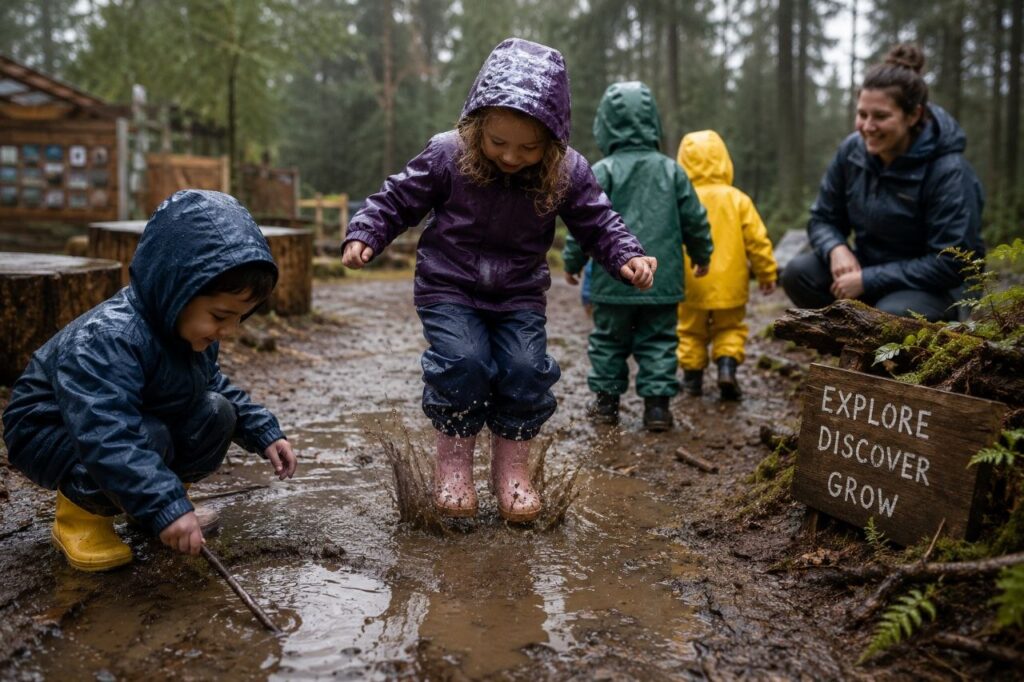
Top-tier childcare centers in Vancouver famously operate under the philosophy that “there is no bad weather, only inappropriate clothing.” Rain, mud, and puddles are not obstacles to learning; they are active invitations for scientific exploration.
When equipped with high-quality rain suits and waterproof boots, children discover concepts of fluid dynamics, gravity, and transformation by splashing in puddles or watching mud flow. Educators use these rainy days to scaffold learning, turning a gloomy afternoon into an exciting investigation of the local water cycle.
Conclusion
Emphasizing outdoor play in BC childcare centers ensures that children receive a well-rounded, natural education that fosters health, creativity, and resilience. By allowing young learners to explore the sights, sounds, and textures of the West Coast environment, families are investing in a future where their children grow up physically robust, mentally sharp, and deeply connected to the world around them.
Leave a Reply