

When parents look for early education, finding the best BC childcare centers is a top priority. Across British Columbia, modern pedagogical standards have shifted away from rigid, academic worksheets for young children. Instead, these premier locations champion an environment where play is recognized as the primary vehicle for development. For toddlers transitioning from infancy into active exploration, structured play is not a break from learning—it is the learning. By deeply engaging with their surroundings, children build foundational cognitive and social structures. Here are six major benefits of play-based learning in early childhood education.
1. Robust Social-Emotional Development
Toddlers are at a developmental stage where they are just beginning to recognize the feelings and presence of others. In high-quality toddler programs in Vancouver, play-based environments provide the perfect testing ground for social interactions. Whether sharing a set of wooden blocks or waiting for a turn on a indoor slide, children naturally learn the basics of negotiation, empathy, and cooperation. Educators guide these moments, helping children label their emotions and develop early self-regulation skills that are critical for future school readiness.
2. Advanced Cognitive Growth and Problem-Solving
When a child plays with open-ended materials, they are constantly testing hypotheses. If a toddler tries to balance a large plastic cup on top of a narrow cardboard tube, they are discovering gravity, balance, and physics through firsthand experience. Accredited BC childcare centers deliberately design play spaces to provoke this kind of curiosity. When a tower falls, the child learns to evaluate what went wrong and try a new strategy. This iterative process builds strong neural pathways dedicated to critical thinking and complex problem-solving.
3. Rapid Language Enrichment and Vocabulary Expansion
Play is naturally communicative. During unstructured or semi-structured play, toddlers constantly vocalize their actions, narrate their thoughts, and interact with peers. Caregivers in toddler programs in Vancouver utilize these playful moments to introduce rich, descriptive language. When a child plays with sand, an educator might introduce words like “gritty,” “sifting,” or “dense.” This contextual learning ensures that language is not just memorized, but deeply understood and integrated into the child’s daily vocabulary.
4. Integration of Fine and Gross Motor Skills
A play-based curriculum keeps children moving, which is essential for physical milestones. Climbing play structures, balancing on sensory beams, and running outdoors develop gross motor strength and spatial awareness. Simultaneously, sensory play like threading large beads, pinching playdough, or using child-safe tweezers refines fine motor muscles. Specialized BC childcare centers ensure that physical movement is woven seamlessly into every aspect of the day, helping toddlers build the hand strength necessary for holding pencils later in life.
5. Cultivation of Imagination and Creative Innovation
In a world increasingly dominated by passive digital screens, play-based learning preserves a child’s natural capacity for deep creativity. When provided with simple materials like cardboard boxes, silk scarves, or dramatic play costumes, toddlers transform their environments into entirely new worlds. This imaginative play encourages abstract thinking, allowing children to understand that one object can represent something else—a foundational concept required for reading, mathematical symbolism, and artistic expression.
6. Building Lifelike Resilience and Confidence
Play involves a healthy amount of trial, error, and mild frustration. A child learning to tie a knot or fit a puzzle piece together might fail multiple times before succeeding. Within the supportive framework of BC childcare centers, children learn that failure is merely a natural step in the learning process. Overcoming these small, self-directed challenges builds an authentic sense of confidence and emotional resilience, teaching toddlers to approach new or difficult tasks with a positive, determined attitude.
How Top-Tier Centers Structure Play Activities
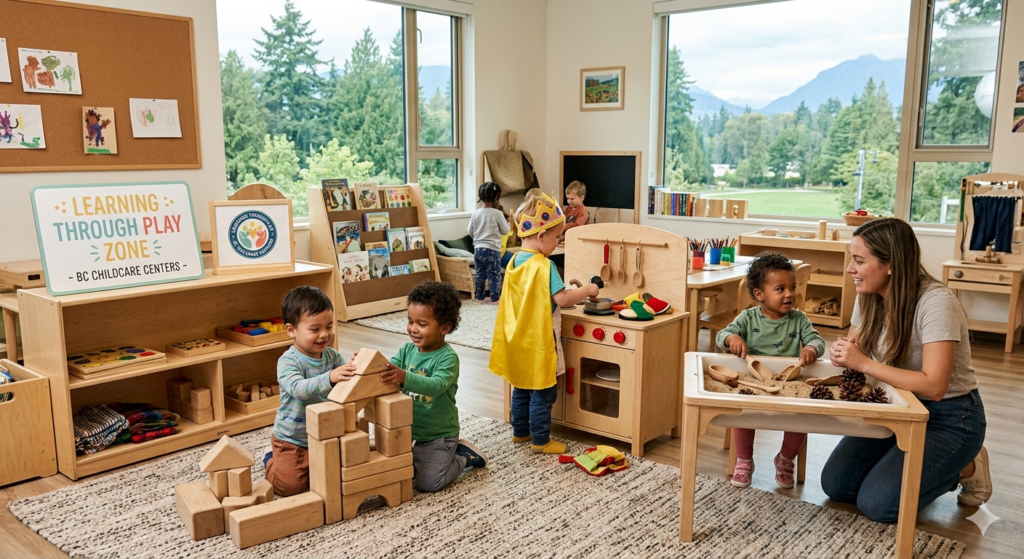
True play-based learning is never accidental; it requires meticulous environmental design by trained early childhood educators. Modern spaces carefully organize “learning centers” or zones within the classroom. A typical room might feature a quiet library corner, an active block building area, a dramatic dress-up kitchen, and a messy sensory table.
By allowing toddlers to freely choose which zone they want to explore, educators foster independence and intrinsic motivation. Furthermore, teachers actively practice “scaffolding”—observing a child’s play and stepping in at precise moments to ask an open-ended question or introduce a new tool, subtly elevating the educational value of the activity without taking control away from the child.
Conclusion
Choosing a play-based curriculum within modern BC childcare centers guarantees a holistic educational foundation for young children. Rather than forcing early academic memorization, this approach nurtures the physical, cognitive, and social-emotional skills that children actually need. By investing in high-quality toddler programs in Vancouver that celebrate intentional play, families ensure their children grow into enthusiastic, curious, and resilient lifelong learners.
Leave a Reply